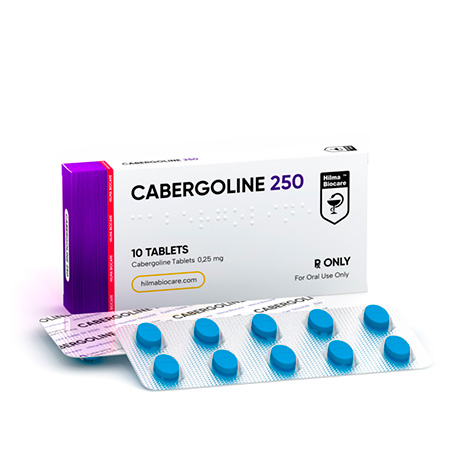
CABERGOLINE (DOSTINEX) (0.25 MG/TABLET – 10 TABLETS)
Cabergoline is an oral medicine containing the active ingredient cabergoline. It belongs to the class of medicines known as dopamine receptor agonists and has a high affinity for dopamine D2 receptors. Its principal pharmacological action is the suppression of prolactin secretion from the anterior pituitary gland.
Prolactin secretion is primarily controlled by inhibitory signals from the hypothalamus, particularly dopamine released by specific hypothalamic neurons. By acting on dopamine receptors, cabergoline reduces plasma prolactin concentrations. The supplied product information describes cabergoline as a long-acting medicine, with its prolonged prolactin-lowering activity associated with its slow elimination and extended half-life.
Pharmacokinetic Profile
Following oral administration, cabergoline is absorbed and reaches peak plasma concentrations approximately 2 to 3 hours after single doses of 0.5 mg to 1.5 mg. The supplied information reports mean peak plasma concentrations of approximately 30 to 70 pg/mL within this period.
Cabergoline is extensively distributed throughout the body and is moderately bound to human plasma proteins, with approximately 40% to 42% protein binding reported in the supplied data.
The medicine undergoes extensive metabolism, predominantly through hydrolysis of the acylurea or urea moiety. Cytochrome P450-mediated metabolism appears to play a minimal role according to the supplied pharmacological information. The major metabolites identified do not contribute significantly to the prolactin-lowering effect.
Cabergoline has a prolonged elimination half-life of approximately 63 to 69 hours. This extended half-life contributes to its sustained pharmacological activity. Following oral administration of radiolabelled cabergoline, the supplied information reports that approximately 22% and 60% of the administered dose were excreted within 20 days through the reported routes, with less than 4% excreted unchanged in urine.
Pharmacodynamic Activity
Cabergoline produces dose-related inhibition of plasma prolactin. In healthy volunteers, prolactin inhibition was observed at doses above 0.2 mg, while higher doses produced stronger and more prolonged suppression.
The supplied clinical pharmacology information reports that cabergoline can selectively inhibit prolactin without an apparent effect on several other anterior pituitary hormones, including growth hormone, FSH, LH, ACTH and TSH, or on cortisol in the referenced studies.
In patients with hyperprolactinaemia, the product information reports a prolonged duration of prolactin suppression following cabergoline administration compared with bromocriptine.
Indications and Uses
According to the supplied information, Cabergoline tablets are indicated for the treatment of hyperprolactinaemic disorders, including idiopathic hyperprolactinaemia and hyperprolactinaemia associated with pituitary adenomas.
The supplied information also lists the following uses:
Lactation suppression.
Treatment of hyperprolactinaemia.
Adjunctive therapy for prolactin-producing pituitary tumours (prolactinomas).
Monotherapy for Parkinson’s disease in the early phase.
Combination therapy with levodopa and a decarboxylase inhibitor in progressive-phase Parkinson’s disease.
Certain dysfunctions associated with hyperprolactinaemia, including amenorrhoea, oligomenorrhoea, anovulation, non-puerperal mastitis and galactorrhoea.
Treatment of uterine fibroids.
Adjunctive therapy of acromegaly where specified.
The appropriate indication depends on the patient’s clinical condition and medical assessment.
Dosage and Administration
The supplied product information states that the recommended starting dosage is 0.25 mg twice weekly. The dosage may be increased by 0.25 mg twice weekly, according to the patient’s serum prolactin level, up to 1 mg twice weekly.
Cabergoline should be taken only as prescribed by a qualified healthcare professional. Dose adjustments should be based on the individual’s clinical response and relevant laboratory monitoring rather than self-directed changes.
CLINICAL PHARMACOLOGY
Cabergoline acts primarily as a dopamine D2 receptor agonist. Dopamine provides inhibitory control over prolactin secretion from the anterior pituitary. Activation of D2 receptors by cabergoline therefore produces suppression of prolactin release.
The supplied data describes a prolonged pharmacological effect, supported by cabergoline’s extensive distribution, metabolism and long elimination half-life. The duration of prolactin suppression can extend considerably beyond the period immediately following administration.
IMPORTANT SAFETY INFORMATION
Cabergoline is a prescription medicine. Its use should be determined by a qualified healthcare professional based on the patient’s diagnosis, medical history and appropriate monitoring.
The supplied product information does not provide a complete adverse-reaction, contraindication or storage section. Therefore, no additional safety claims or specifications have been added beyond the information provided.
PRESENTATION
Cabergoline 0.25 mg tablets – 10 tablets.
STORAGE
Specific storage conditions were not provided in the supplied product information. Follow the storage instructions stated on the product packaging or accompanying official documentation.